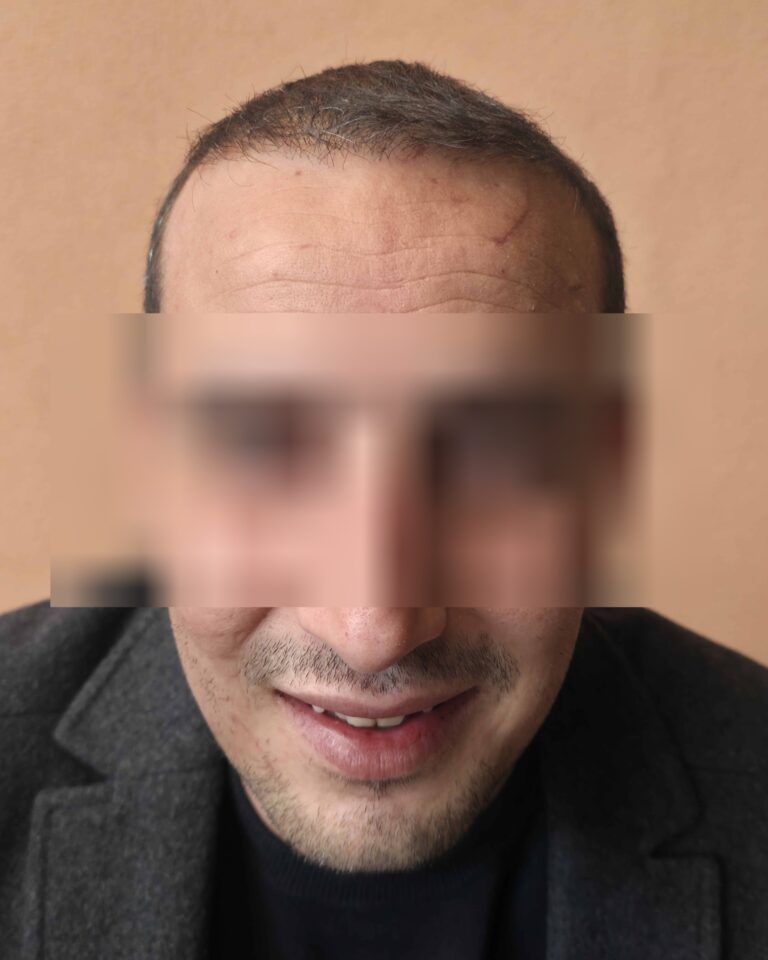
How does Long Hair FUE (the long-hair transplant) work?
The no-shave hair transplant, or Long Hair FUE, harvests and then re-implants the follicular units while keeping the hair at its full length. Neither the donor area nor the recipient area is shaved. Its main benefit: no visible sign of surgery from the moment you leave the practice.
What is the no-shave hair transplant (Long Hair FUE)?
Long Hair FUE (Long Hair Follicular Unit Excision) is an advanced variant of FUE in which each follicular unit is harvested with its hair shaft intact, then re-implanted with the hair long. The concept was described as early as 2006 by Dr Marcelo Pitchon in the Hair Transplant Forum International, the ISHRS journal, under the name “preview long hair”. Unlike classic FUE, which requires shaving at least the donor area, Long Hair FUE leaves the hair visually intact. Another specificity: since the hairs are implanted long, the patient leaves the procedure with an immediate — temporary — preview of the future result.
FUE today accounts for 85.4% of male hair transplants worldwide (ISHRS, Practice Census 2025). Long Hair FUE is its most technically demanding evolution, which explains why it remains uncommon (Umar et al., 2023).
How does a no-shave transplant proceed, step by step?
A Long Hair FUE follows the same surgical framework as an FUE, with one additional constraint at every step: preserving the surrounding long hair. At the Dar El Hakim practice (Djerba), the division of roles is constant. Dr El Cadhi personally performs: consultation, marking, anaesthesia, FUE harvesting, sapphire incisions and DHI implantation. His medical assistants intervene only for post-incision extraction, sorting and trimming of the grafts under the microscope, and insertion with the K.E.E.P. implanter into the incisions previously opened by the physician.
| Step | What happens | Operator |
|---|---|---|
| 1. Consultation and marking | Scalp examination, hairline design, graft distribution plan | Dr El Cadhi |
| 2. Local anaesthesia | Anaesthesia of the donor area, then of the recipient area | Dr El Cadhi |
| 3. Long-hair FUE harvesting | Separating the locks, locating and incising each follicular unit at a precise angle | Dr El Cadhi |
| 4. Extraction, sorting and trimming | Post-incision extraction, sorting and preparation of the grafts under the microscope | Medical assistants |
| 5. Sapphire incisions | Opening the recipient sites: angle, direction and density set by the plan | Dr El Cadhi |
| 6. Implantation | DHI implantation of the long-hair grafts; insertion with the K.E.E.P. implanter into the incisions already opened | Dr El Cadhi · medical assistants |
The major difference from a shaved FUE lies in step 3. Without shaving, each follicular unit has to be isolated beneath the locks that are kept, located along its natural axis and incised without damaging the neighbouring follicles. This unit-by-unit work explains the longer operating time.
Why do so few surgeons perform Long Hair FUE?
The literature describes a technique that requires advanced skills and a longer operating time than standard FUE (Umar et al., Clinical, Cosmetic and Investigational Dermatology, 2023).
The reason is manual: long-hair extraction cannot be automated. It is learned through mentorship, at the cost of thousands of hours of practice, because the angle of attack of the punch has to be read beneath a lock that hides where the follicle exits the skin. Few teams accept that investment while shaved FUE, which is faster, remains the market norm.
What equipment makes long-hair harvesting possible?
Long-hair harvesting relies on specific instruments. In our 2026 Long Hair FUE case series (n = 3, documented as part of an inter-university diploma (DIU) thesis — Dar El Hakim medical complexal data), the equipment used comprises a 0.8 mm Lurup hybrid punch, an ECube extraction motor and Sharp Implanters. This series tracks extraction quality indicators — graft transection rate (GTR), SBR — as well as harvesting speed, in order to document the reproducibility of the technique.
The reduced diameter of the punch limits the size of the harvesting points, which matters all the more since the donor area is not shaved. The micro-incisions remain hidden beneath the hair that is kept from the end of the procedure.
How many grafts can be implanted in one no-shave session?
For an equal operating time, a no-shave session generally covers fewer grafts than a shaved FUE: selecting and extracting unit by unit beneath long locks slows down every step. The achievable volume depends on three factors: the density of the donor area, the extent of the area to be covered, and the technical feasibility specific to the patient’s scalp.
This is why the indication is assessed case by case. For very extensive coverage, a classic FUE may remain more suitable. For a hairline, temples or targeted densification, Long Hair FUE comes into its own. The ForceHT 3D simulation lets you visualise the project before the procedure, and only the assessment at the consultation sets the number of grafts.
Is the result the same as with a classic FUE?
Published series report satisfactory clinical results when Long Hair FUE is performed by a trained operator (Umar et al., 2023). The quality of the result depends more on execution — graft selection, angle, density — than on whether or not the head is shaved. The choice of surgeon is therefore decisive, even more so than for a standard FUE or DHI.
The timeline, however, differs at the start: the patient benefits from an immediate preview with the implanted long hairs, then these shafts go through a transient shedding in the following weeks. Regrowth then sets in gradually and the result is assessed over about twelve months, as for any hair transplant. Results may vary according to each patient’s hair profile.
Who is the no-shave transplant for — and what are its limits?
Long Hair FUE is aimed first at people for whom a visible “shaved” period is out of the question: women, people in exposed professions, and anyone wanting complete discretion towards those around them. We have detailed these profiles in a dedicated article: who is the no-shave transplant indicated for?
Its limits mirror its demands: longer operating time, shorter sessions in terms of graft numbers, rigorous candidate selection and a cost generally higher than a shaved FUE. Eligibility — type of alopecia, quality of the donor area, coverage goal — is confirmed at a scalp examination, presented on the Long Hair FUE in Djerba page.
Frequently asked questions about the no-shave transplant
Does a no-shave transplant leave scars?
Like any FUE, Long Hair FUE leaves dot-like micro-scars at the harvesting points, in practice hidden by the hair that is kept. It does not involve a linear scar, unlike the FUT strip technique. Their final visibility depends on the punch diameter, donor density and each patient’s own healing.
Can you go back to work the next day?
The donor area remains covered by the long hair from the moment you leave the practice. Small crusts may persist for a few days on the recipient area, depending on its location. Many patients quickly resume office work; the exact timing is set at the consultation, according to the treated area and the job.
Does Long Hair FUE cost more than a classic FUE?
Generally yes. Unit-by-unit harvesting beneath long locks markedly lengthens the operating time, which is reflected in the price. The cost depends on the number of grafts and the complexity of the case; a personalised quote is drawn up after assessment of the file, without commitment. See the pricing page.
What is the difference between Long Hair FUE and DHI?
Long Hair FUE refers to the harvesting method: extracting the follicles with the hair long, without shaving. DHI refers to a direct implantation method using an implanter. The two are combined within the same procedure: long-hair harvesting, then direct implantation of the grafts into the incisions opened by the surgeon.
Can women have a no-shave transplant?
Yes — it is one of its major indications. Long Hair FUE avoids shaving, rarely an option for a female patient, and makes it possible to treat a widened parting or temples with complete discretion. The indication depends on the type of alopecia, confirmed at a scalp examination during the consultation.
Is the result visible immediately after the procedure?
Yes, temporarily: since the grafts are implanted with the hair long, the patient leaves with an immediate preview of the hair project — the “preview”. These shafts then shed transiently in the following weeks, before gradual regrowth; the result is assessed over about twelve months.
How long does a Long Hair FUE session last?
Longer than an equivalent shaved FUE: separating the locks and extracting unit by unit slows down every stage of harvesting. The duration varies with the planned number of grafts and the density of the donor area; it is specified when the operating plan is drawn up.
Dr Khalil El Cadhi, hair transplant surgeon, ISHRS Full Member — Djerba, Tunisia.
Registered with the Tunisian Medical Council under number 026253 · Dar El Hakim practice.
Published 11 June 2026 · Last medical review: 11 June 2026.
References
- Umar S. et al. No-Shave Long Hair Follicular Unit Excision Using an All-Purpose Skin-Responsive Device. Clin Cosmet Investig Dermatol. 2023;16:3681-3691. DOI 10.2147/CCID.S442822.
- ISHRS. Practice Census 2025 (2024 data). ishrs.org.
- Pitchon M. Preview long hair transplantation. Hair Transplant Forum International, 2006.
- ISHRS profile of Dr Khalil El Cadhi.
Results depend on each patient’s individual profile. No result can be guaranteed. This article is for information purposes and does not constitute personalised medical advice. Any surgical indication requires a prior consultation.
Your case
Discuss your case on WhatsApp · quote within 24 h
Open WhatsAppQuote within 24 h after photos · send 3 photos on WhatsApp: front, vertex, donor area.