
Female
hair transplant.
Performed personally by Dr Khalil El Cadhi, hair transplant surgeon · Full Member ISHRS (directory verified on 29/07/2026) · from €1 per graft (FUE) · €3 with no-shave Long Hair FUE · quote within 24 h after photos
A discipline in its own right within hair transplant surgery. Imperative preservation of existing hair, rounded hairline, respected temple points. Long Hair FUE, the no-shave technique, is the reference solution.
Quote within 24 h after photos · send 3 photos on WhatsApp: front, vertex, donor area.★★★★★5.0 / 5 from 47 Google reviews No-shave prioritized
Three female specificities.
Three structural differences set female hair transplant apart from male transplant. Preservation of existing hair — female patients can neither socially nor psychologically tolerate a shaved coiffure. Hairline architecture — rounded, without marked temple recession. Hormonal context — often linked to imbalance (cycle, post-partum, menopause) or iron deficiency.
Female transplant is rarely an isolated procedure: it fits within a broader therapeutic plan including identifying the cause of hair loss, treating it, then surgery as visual consolidation.
Female indications.
Pattern hair loss
Ludwig I to III. The most frequent form, characterized by diffuse crown and temple thinning.
Traction alopecia
Sequelae of tight hairstyles maintained over years (extensions, tight braids, permanent high ponytails).
Post-partum or scarring
Stabilized after 12-18 months post-partum. Sequelae of lichen planopilaris, burns, surgical scars.
Five steps,
in Long Hair FUE.
- 01
Consultation and hormonal workup
Capilloscopic examination, Ludwig classification, mapping with ScanScalp.ai. Biological workup: ferritin, TSH, hormonal serology. Rule out non-stabilized progressive alopecia.
- 02
Long Hair FUE prioritized
Without shaving whenever possible. Extraction and implantation without touching the patient’s coiffure. For very large volumes, classic FUE discussed.
- 03
Tumescent anesthesia
Tumescent local anesthesia. No systemic sedation. The patient remains awake, can communicate.
- 04
Extraction and implantation
Unit extraction under long shaft. Implantation respecting the rounded female hairline, discretely marked temple points, and crown target density.
- 05
Finishing and follow-up
Duration 5 to 8 hours for 1,500 to 3,000 grafts. Standardized photographic follow-up at M+3, M+6 and M+12.
Seven milestones
over twelve months.
Female-specific:
more marked shock loss.
Shock loss may be accompanied by a more marked reactive telogen effluvium in women — transient shedding of native hairs around grafted sites, which resolves spontaneously in 2-3 months. Regrowth becomes clinically observable at 3 months, consolidated result at 12 months.
Contraindications
Female-specific contraindications: non-stabilized progressive alopecia (acute telogen effluvium), uncorrected iron deficiency, unbalanced thyroid dysfunction, current or recent pregnancy, breastfeeding, active lichen planopilaris.
From
€1 / graft (FUE)
€1 in FUE · €2 in FUE + DHI · €3 in no-shave Long Hair FUE. A frontal densification project typically represents 1,500 to 2,500 grafts in Long Hair FUE. Personalized quote within 24 h after photos, confirmed at consultation.
Common questions.
Do I need to shave for a female transplant? +
No, not in Long Hair FUE — the technique prioritized for women at Dr El Cadhi’s clinic. Extraction and implantation without touching your coiffure.
When after pregnancy? +
Not before 12-18 months after delivery, and only if any post-partum shedding has stabilized. Ongoing pregnancy and breastfeeding contraindicate any hair transplant surgery.
Possible with diffuse alopecia? +
Yes for stabilized androgenetic forms (Ludwig I-III). More delicate for non-androgenetic diffuse alopecia, which often requires medical treatment prior to surgery.
How to manage regrowth socially? +
The major advantage of Long Hair FUE: your coiffure is preserved on the day of the procedure. Light frontal edema may persist for 3-5 days, but no ‘shaved’ appearance is visible.
Hormonal follow-up after? +
A later hormonal relapse can affect overall density even after a successful transplant — long-term medical follow-up is recommended.
Outcome guarantees? +
No ethical hair transplant surgeon can guarantee a regrowth percentage — ISHRS rules forbid such claims.
Discretion. One patient operated on per day, a small team. Your photos are never published without your written consent.
Consult Dr El Cadhi
for a female transplant.
Video consultation possible. Dr Khalil El Cadhi receives patients in person at the Dar El Hakim medical complex in Djerba.
Request a consultation via WhatsAppQuote within 24 h after photos · send 3 photos on WhatsApp: front, vertex, donor area.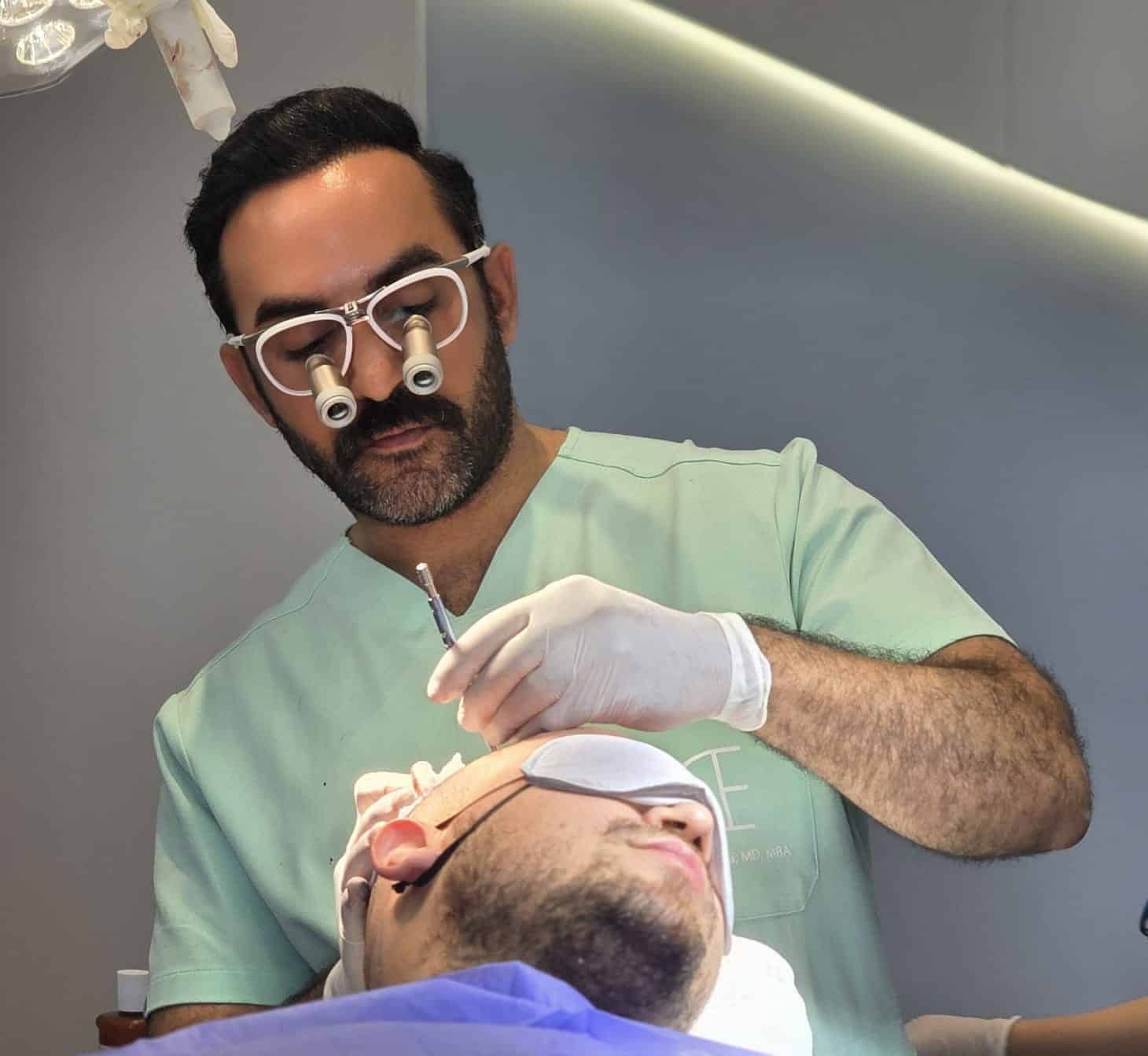 Written and reviewed by Dr Khalil El Cadhi, Full Member ISHRS, Medical Council reg. 026253 — updated 8 June 2026