
FUE,
unit extraction.
Performed personally by Dr Khalil El Cadhi, hair transplant surgeon · Full Member ISHRS (directory verified on 29/07/2026) · from €1 per graft (FUE) · quote within 24 h after photos
The reference technique of modern hair restoration. Unit-by-unit extraction of follicles, calibrated preservation and millimetric implantation. No linear scar.
Quote within 24 h after photos · send 3 photos on WhatsApp: front, vertex, donor area.★★★★★5.0 / 5 from 47 Google reviews Reference since 2000
The reference technique
since 2000.
FUE — Follicular Unit Extraction — first appeared in the literature in the early 2000s and progressively established itself as the alternative to strip surgery (FUT). Where FUT harvests a sutured strip of scalp — leaving a linear occipital scar — FUE extracts each follicular unit individually using a 0.7 to 0.9 mm rotary micro-punch.
No linear incision, no visible scarring. The donor area heals as tiny depigmented dots, invisible at short hair lengths. This difference is not just cosmetic: FUE enables selective extraction of the most biologically stable follicular units — those of the occipital fringe, genetically resistant to androgen action.
Who is FUE hair transplant for?
Pattern hair loss
Norwood stage II to VI in men. Ludwig I to III in women. The majority indication — the vast majority of cases.
Facial transplant
Beard and eyebrow — FUE is the only technique compatible with these zones, where the skin tolerates neither FUT nor wide shaving.
Repair & scars
FUE allows extraction of misplaced grafts and camouflages traumatic or surgical scars through targeted densification.
How does
an FUE hair transplant work?
- 01
Consultation and planning
Capilloscopic examination, Norwood/Ludwig classification, donor reserve calculation, density mapping with ScanScalp.ai. Full pre-operative biological workup.
- 02
Shaving and anesthesia
Donor-area shaving to 1 mm — enables direct visualization of follicular units under loupe. Tumescent local anesthesia, no systemic sedation.
- 03
Unit-by-unit extraction
Each follicular unit (1, 2, 3 or 4 hairs) extracted individually with rotary micro-punch. Millimetric precision repeated thousands of times.
- 04
Sorting and preservation
Sorting by caliber under binocular loupe, preservation in 4°C holding solution. Proprietary ForceHT protocol to optimize take rate.
- 05
Millimetric implantation
Recipient sites incised with blade, implantation with forceps per pre-operative design. Single-hair units in front line, 2-4 hair units for density. Duration 5 to 8 hours for 1,500 to 3,500 grafts.
Seven milestones
over twelve months.
Why do grafted hairs
shed before regrowing?
The physiological shedding phase (shock loss) occurs between weeks 2 and 6 post-op. Expected, predictable, documented in ISHRS literature — never a therapeutic failure. Definitive regrowth observable between months 9 and 12.
Contraindications
Transient edema 3-5 days, donor-area sensitivity, superficial scabs 7-10 days. Contraindications: non-stabilized progressive alopecia, coagulation disorders, active autoimmune disease, recent isotretinoin, ongoing pregnancy.
From
€1 / graft
Final price depends on graft volume (1,500 to 4,500), technical complexity and donor-area quality. Personalized quote after consultation.
Common questions.
How many grafts in one FUE session? +
Between 1,500 and 4,500 grafts depending on donor-area quality and technical complexity. Beyond that, out-of-body time of the last extracted grafts compromises their survival.
Difference between FUE and DHI? +
Both techniques share the same extraction phase. FUE first creates recipient sites then places grafts with forceps; DHI uses a Choi pen that incises and implants in a single gesture.
Does FUE leave scars? +
FUE leaves tiny depigmented dots under 1 mm on the donor area — invisible at short hair lengths (from 3 mm), totally masked at long hair lengths.
When can sport resume? +
Moderate sport from M+1, intensive sport and heavy weightlifting from M+2. Chlorinated pool swimming discouraged before M+1.
Lifelong medication? +
Not necessarily. Follicles transplanted from the occipital fringe retain their genetic resistance to androgens. For native hair stabilization, finasteride or minoxidil may be recommended on individual medical indication.
Outcome guarantees? +
No ethical hair transplant surgeon can guarantee a regrowth percentage — ISHRS editorial rules explicitly forbid such claims. Dr El Cadhi presents the spectrum of outcomes observed in comparable case files.
Consult Dr El Cadhi
for an FUE procedure.
Video consultation possible from France, Belgium, Switzerland or the Maghreb. Dar El Hakim medical complex in Djerba — two flight-hours from Paris.
Request a consultation via WhatsAppQuote within 24 h after photos · send 3 photos on WhatsApp: front, vertex, donor area.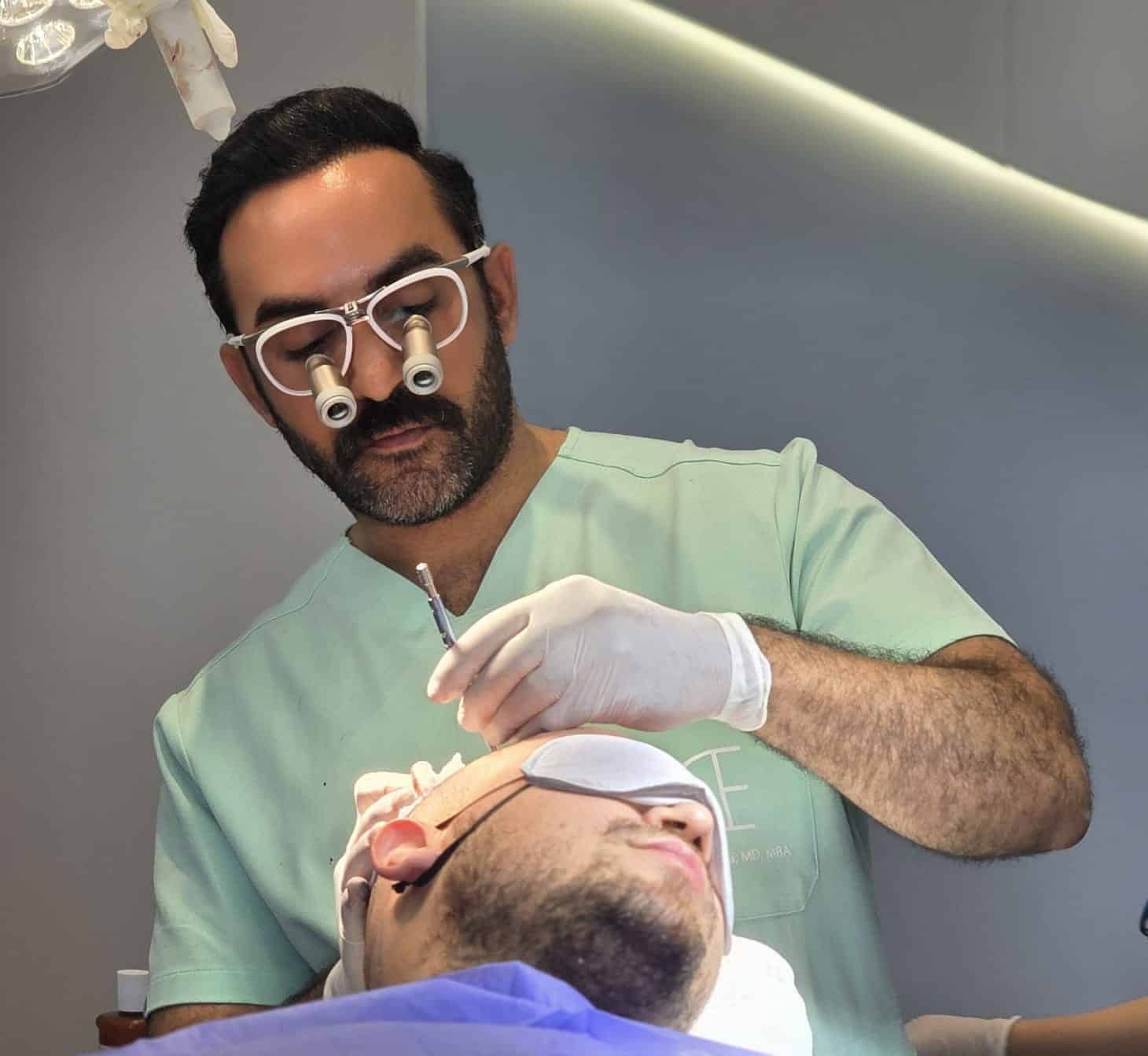 Written and reviewed by Dr Khalil El Cadhi, Full Member ISHRS, Medical Council reg. 026253 — updated 8 June 2026