
DHI,
with Choi pen.
Performed personally by Dr Khalil El Cadhi, hair transplant surgeon · Full Member ISHRS (directory verified on 29/07/2026) · from €2 per graft (FUE + DHI) · quote within 24 h after photos
An evolved FUE variant in which implantation is performed directly with Choi pens, without prior recipient channel creation. Millimetric and three-dimensional control of angle, depth and direction.
Quote within 24 h after photos · send 3 photos on WhatsApp: front, vertex, donor area.★★★★★5.0 / 5 from more than 50 Google reviews Millimetric precision
Direct
Choi pen implantation.
DHI — Direct Hair Implantation — belongs to the same technical family as classic FUE: follicular unit extraction is performed identically. The operative difference arises at the next step.
Where classic FUE requires two distinct stages — pre-creation of recipient sites with a blade, then graft insertion with forceps — DHI merges these two gestures into one. The graft is loaded into a Choi pen (named after its South Korean inventor), whose hollow tip incises the skin and simultaneously releases the follicle at the desired depth, angle and direction.
Who is DHI implantation for?
Targeted densification
Of an area already partially grafted or naturally thinning. DHI allows insertion of new grafts without damaging existing follicles.
Female temple areas
The rounded female hairline and fine temporal zones demand the angular control DHI offers natively.
Scarred zones
The fine Choi pen tip minimizes cutaneous trauma on scarred scalp and preserves local vascularization.
How does
a DHI transplant with the Choi pen work?
- 01
Consultation and planning
Identical to any FUE transplant: capilloscopic examination, density mapping with ScanScalp.ai, validated hairline design.
- 02
Preparation and extraction
Donor-area shaving to 1 mm, tumescent anesthesia, unit-by-unit extraction with rotary micro-punch. Extraction phase strictly identical to classic FUE.
- 03
Choi pen loading
Each graft manually loaded into the hollow tip of the pen by trained assistants. Multiple pens used in alternation to maintain pace.
- 04
Direct implantation
The surgeon holds the pen, chooses the exact incision angle, applies the tip to the skin, penetrates at the defined depth, then presses the plunger to release the graft. Continuous control — not delegated to assistants.
- 05
Final check
Re-checking the angle, depth and direction of every graft. Final dressing on donor area only.
Seven milestones
over twelve months.
What follow-up
after a DHI transplant?
DHI recovery is strictly identical to classic FUE. DHI’s specific benefit lies in angular precision — particularly perceptible on the fronto-temporal hairline, where the natural feathered effect is better preserved than with standard classic FUE.
Contraindications
Contraindications identical to FUE: non-stabilized progressive alopecia, coagulation disorders, active autoimmune disease, recent isotretinoin, ongoing pregnancy.
From
€2 / graft
Pricing may vary based on technical complexity (fine densification, hairline angular control, scar tissue). Personalized quote after consultation.
Common questions.
DHI or classic FUE — which to choose? +
DHI excels at densifications, female temple areas and demanding hairlines. Classic FUE is more efficient for very large volumes (>3,500 grafts). Choice made case by case at consultation.
How many grafts in a DHI session? +
Typically between 1,500 and 3,000 grafts. DHI’s slower operative pace makes very large volumes poorly suited to a single session.
Is DHI more painful than FUE? +
No. Tumescent local anesthesia is identical. The Choi pen tip being finer than a standard incision blade, some patients even report slightly more comfortable post-op suites.
How long does a DHI session last? +
Between 6 and 9 hours depending on volume. Per-hour pace is lower than classic FUE due to the load-incise-release cycle specific to each graft.
Does DHI require shaving? +
Yes for the donor area, shaved to 1 mm on the morning of the procedure. Recipient area generally not shaved. For a fully no-shave variant, see Long Hair FUE.
Outcome guarantees? +
No ethical hair transplant surgeon can guarantee a regrowth percentage — ISHRS rules forbid such claims. Dr El Cadhi presents the spectrum of outcomes observed in comparable case files.
Consult Dr El Cadhi
for a DHI procedure.
Video consultation possible. Dr Khalil El Cadhi receives patients in person at the Dar El Hakim medical complex in Djerba — two flight-hours from Paris.
Request a consultation via WhatsAppQuote within 24 h after photos · send 3 photos on WhatsApp: front, vertex, donor area.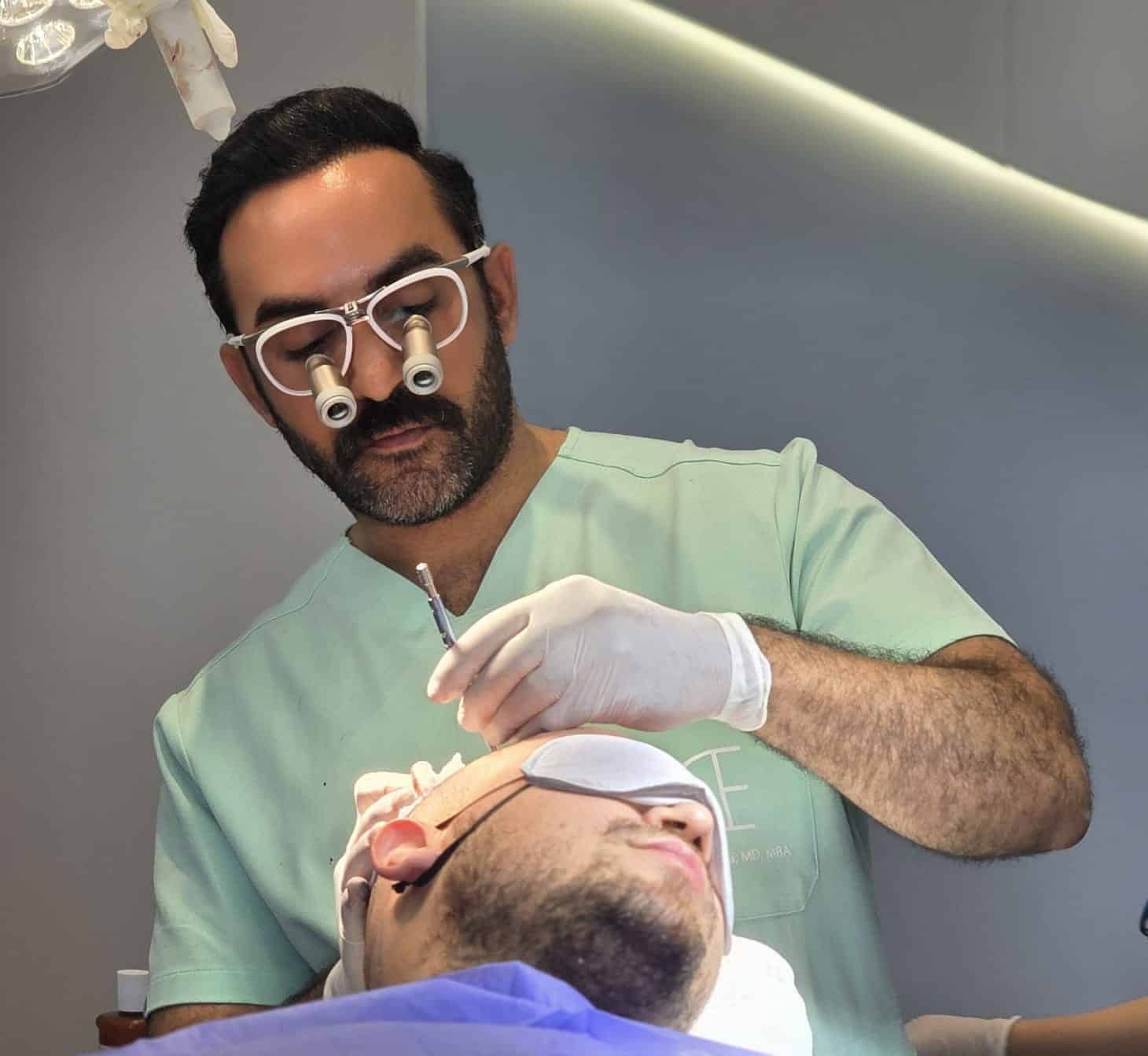 Written and reviewed by Dr Khalil El Cadhi, Full Member ISHRS, Medical Council reg. 026253 — updated 8 June 2026