
Hair transplant
repair.
Performed personally by Dr Khalil El Cadhi, hair transplant surgeon · Full Member ISHRS (directory verified on 29/07/2026) · €1 per graft in FUE · €2 in FUE + DHI · €3 in Long Hair FUE + DHI, depending on the technique chosen at quote stage · quote within 24 h after photos
One of the most sensitive indications in hair transplant surgery. Low hairline, wrong angles, plug-look, visible scars, donor reserve waste — every repair case is unique and requires fully personalized operative planning.
Quote within 24 h after photos · send 3 photos on WhatsApp: front, vertex, donor area.★★★★★5.0 / 5 from more than 50 Google reviews Forensic analysis
Six common defects.
A failed hair transplant covers distinct clinical situations: poorly designed hairline (too low, too straight), incorrect implantation angles (pin-cushion effect), plug-look (tight 3-4 hair clumps), visible scarring (moth-eaten donor area), insufficient density (failed cold chain), donor area waste.
Dr El Cadhi regularly receives patients seeking revision after procedures performed in Turkey, Tunisia or elsewhere. Based on consultation analysis, the corrective strategy combines several complementary techniques.
Four repair strategies.
Redirection & redistribution
When angles are incorrect: extraction of misplaced grafts via reverse FUE, then reimplantation in the correct direction.
Targeted densification
If initial density is insufficient but architecture is correct, densification FUE targets sparse zones precisely.
Scar camouflage
Visible donor-area scars camouflaged by FUE implantation of isolated grafts directly into the scar tissue.
Five steps,
a forensic analysis.
- 01
Forensic file analysis
Critical step. Dr El Cadhi precisely analyzes the existing result: multi-angle photographs, capilloscopic examination, density measurement with ScanScalp.ai, scar assessment, aberrant angles identification.
- 02
Personalized operative plan
No case resembles another. Combination of several strategies (redirection, densification, camouflage, redesign) per identified defects. 1 to 3 sessions 9 to 12 months apart.
- 03
Donor reserve verification
Before any revision, systematic verification of alopecia stability and residual donor reserve. Repair on patient with non-stabilized progressive alopecia would fail medium-term.
- 04
Combined intervention
Per defects: reverse extraction to correct angles, densification FUE, and millimetric corrective implantation. Typically longer than primary grafting — 7 to 10 hours for 1,500-2,500 grafts.
- 05
Long follow-up
On scar tissue, follicular take rate is typically 60-80% versus 85-95% on healthy tissue. Assessment at M+3, M+6, M+12, M+18.
Seven milestones
over twelve months.
Significant improvement,
not 100%.
Repair improves but never restores 100% of lost follicular potential. Best-corrected defects are aberrant angles, plug-look, and visible scars. Hairlines too low are harder to correct without long reverse transplantation.
Contraindications
Higher risks on scar tissue: lower take rate, slower healing, slightly increased ingrown-hair risk. Contraindications: non-stabilized progressive alopecia, exhausted donor reserve, constitutional scar disorders (keloids).
From
€1 / graft (FUE)
€1 in FUE · €2 in FUE + DHI · €3 in Long Hair FUE + DHI, depending on the technique chosen at quote stage.
Common questions.
How many sessions for a repair? +
One to three sessions 9 to 12 months apart depending on complexity. Most cases resolved in two sessions.
Delay after first transplant? +
At least 12 months after first procedure, to allow full maturation of previous grafts and reliable evaluation.
Can a failed Turkish transplant be corrected? +
Yes, in the vast majority of cases. Dr El Cadhi regularly receives patients seeking revision after a transplant performed in Turkey. Forensic analysis determines the corrective strategy.
What if my donor area is exhausted? +
Limited options. Beard extraction (BHT – Body Hair Transplant) to supplement, or camouflage via medical tricopigmentation.
Will the result be completely natural? +
Goal is significant improvement and maximum naturalness given initial state. Clear improvement achieved in vast majority of cases.
Outcome guarantees? +
No ethical hair transplant surgeon can guarantee a regrowth percentage — ISHRS rules explicitly forbid such claims.
Consult Dr El Cadhi
for a repair.
Video consultation possible with prior submission of pre and post-op photographs of the transplant to be corrected. Dar El Hakim medical complex in Djerba — two flight-hours from Paris.
Request a consultation via WhatsAppQuote within 24 h after photos · send 3 photos on WhatsApp: front, vertex, donor area.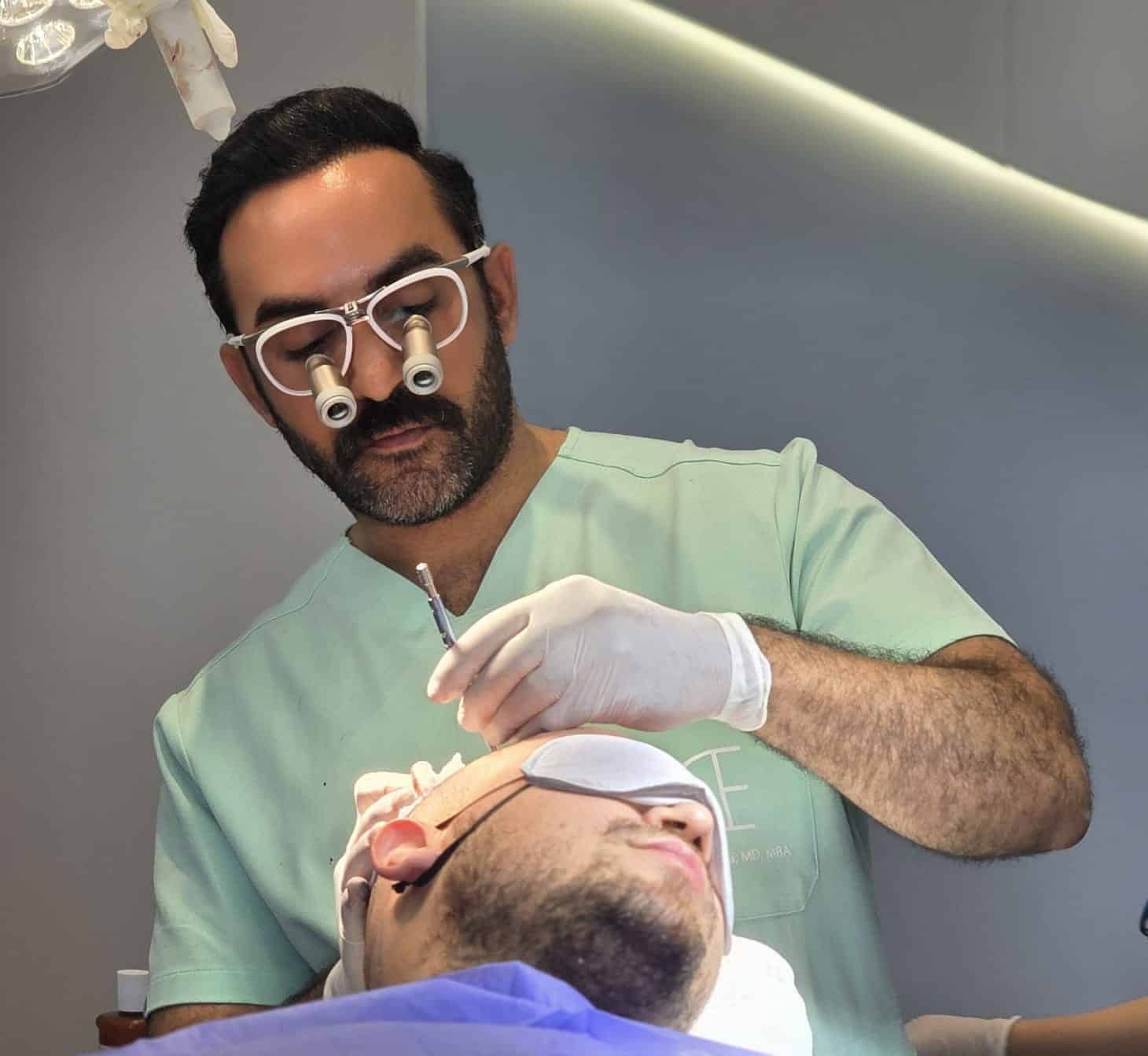 Written and reviewed by Dr Khalil El Cadhi, Full Member ISHRS, Medical Council reg. 026253 — updated 8 June 2026